PokéSurvivor Game Guide 2026: How to Play, Unlock Pokémon, and Survivor
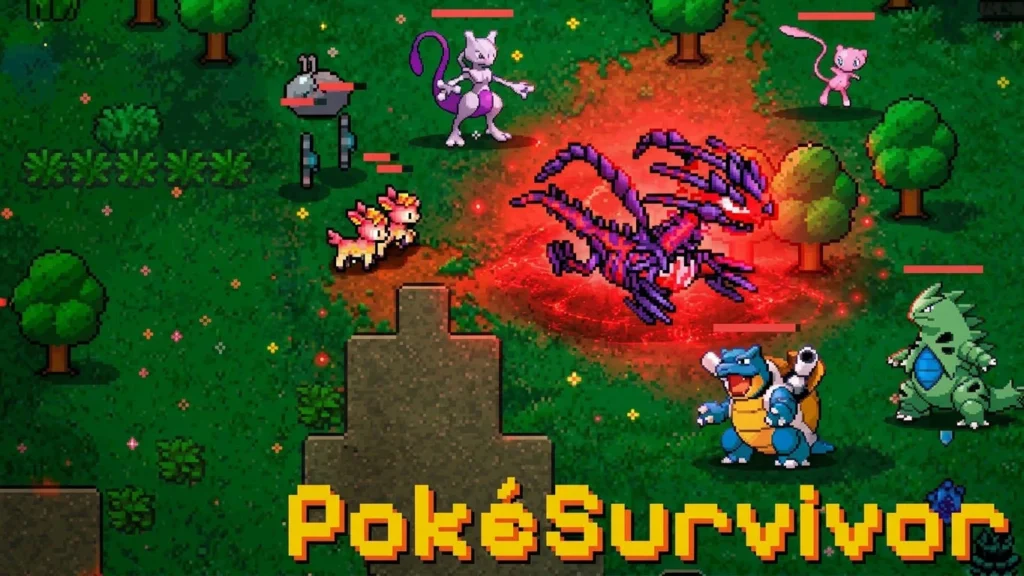
PokéSurvivor is a free browser survival game where you choose a Pokémon partner, dodge growing hordes and shape your build while attacks fire automatically.
Quick answer
A free browser survivor game with 966 partners and a wall at minute 30. Here is the full loop — the move switcher, evolution requirements, type and weather maths, held items, shiny odds, legendary rifts, four-player co-op, and what actually happens when Arceus arrives.

PokéSurvivor is a free, browser-based Pokémon survivor game in the roguelite bullet-heaven genre. It plays like Vampire Survivors with a monster-catching roster: your active move fires automatically, you steer with WASD or a thumb drag, and every level-up hands you three cards. The roster is 966 playable Pokémon across nine regions, with online co-op for up to four players.
Only the active slot casts its moves. Learning another move gives you a switching option, not another automatically active attack. Bonds can combine up to four moves in that slot so they cast together. See the active-slot and Bond implementation.
What PokéSurvivor is
PokéSurvivor combines automatic combat with move switching, type matchups and a collection of 966 playable Pokémon. You move through an endless map, collect experience, and choose upgrades while wild Pokémon try to surround you. Enemy roles, changing weather and legendary encounters give you more to manage than movement alone.
The official guide compares PokéSurvivor with Vampire Survivors and Survivor.io. Its Mystery Dungeon-style sprites accompany a different combat decision: you switch the active move slot rather than simply collecting weapons that all fire together.
PokéSurvivor is an unofficial, non-commercial fan project without affiliation to Nintendo, Creatures Inc., GAME FREAK or The Pokémon Company. The developer states that it has no ads or purchases; optional donations fund hosting and the domain without gameplay advantages. There is no official cryptocurrency, token or NFT. Use pokesurvivor.com, the official game website, for access and the legal notice.
| Genre | Survivor-like / bullet heaven with a monster-catching roster |
|---|---|
| Platform | Browser on PC, phone or tablet; installable to the home screen |
| Price | Free, no ads, no purchases; tickets are earned in play |
| Roster | 966 playable Pokémon, nine regions, Kanto through Paldea |
| Languages | English and Spanish |
| Multiplayer | Online co-op, up to 4 players |
| Achievements | 130, spanning collection, survival, combat, rifts and group play |
| Run length | Survival time varies; the Judgment of Arceus begins at 30:00 |
Two things about that roster are easy to misread. First, 966 is the playable roster, not every species in the mainline franchise. Second, “playable” and “available right now” are different states — you start with a starter and build outward, which is what the unlock section below is about.
How PokéSurvivor differs from other survivor games
PokéSurvivor combines automatic combat with Pokémon collection, regional ticket pools and a move switcher. If you enjoy planning short survival runs and collecting partners, those are the features to assess first. The official guide describes the core controls and systems; this article expands on how they interact.
Check which Pokémon survivor game a guide covers
Use the project identity rather than a similar title to identify the game: this guide covers pokesurvivor.com and JPTER78/pokesurvivor on GitHub. Advice for a similarly named game may use different mechanics. Arceus alone is not a reliable way to distinguish projects: PokéSurvivor lists a defeatable rift encounter as well as an invincible Judgment pursuer.
Start your run and learn the move switcher
The personality questionnaire recommends a partner, but you can choose another. The starting selection contains 29 Pokémon: the three starters from each of nine regions, plus Psyduck and Slowpoke. Those two start with Confusion; other Water starters can begin with Water Gun or Bubble, so check the actual move rather than choosing by type alone. See the starter definitions.
Pick a Pokémon you actually want to learn, then concentrate on its starting attack before experimenting with the whole roster. The single most useful habit in this game is knowing exactly what your active move does — its range, its cooldown, and whether it hits behind you.
| Action | PC | Phone / tablet |
|---|---|---|
| Move | WASD or arrow keys | Drag your finger anywhere on screen |
| Switch moves | 1–4, Q/E, or click a move icon | Tap a move icon |
| Pause | Esc | Tap the pause button, top right |
Practice switching while the battlefield is manageable. A damaging move, a buff and a close-range attack require different positioning. Check the active slot after a loadout change: an unlinked buff does not replace a damaging attack.
The opening sequence that works
- Keep moving in wide circles. Draw enemies behind you while preserving an escape route.
- Collect the experience you create. Walk over dropped XP instead of leaving it inside a growing crowd.
- Choose cards for the immediate problem. Upgrade damage when enemies stop falling; take movement or defensive options when they keep catching you.
- Read ground warnings. Leave filling circles and lines before the attack lands, not after.
- Target support enemies. Remove healers and shield-casters before their allies become harder to clear.
And the rule that prevents most early deaths: never charge into a packed group for one pickup. Circle back after your attack has created room. Watch terrain and obstacles as closely as the enemies — an escape route only helps if you can actually move through it.
Moves, cards and evolution
Leveling up offers three cards. Those choices can teach a new move, improve an existing attack, or boost your Pokémon. Strengthen the attack you actively use before spreading upgrades across several moves that still need investment — a level-1 move you never select is a wasted card, no matter how good its damage number looks.
The evolution rule, precisely
Move evolution is the system most guides describe loosely, so here is the exact sequence as the current build enforces it:
Three conditions, all inside one run
1. The move reaches its maximum level (level 5).
2. You take that move’s specific stat card during the run.
3. You are offered — and choose — the golden evolution card.
Ember evolves into Fire Blast with Power, Bubble into Surf with Sprint, and Razor Leaf with Reflexes. The required stat card belongs to the individual move, not its type. Meeting the prerequisites makes the golden card eligible to appear; you must still select it. Buff moves do not evolve. See the move evolution definitions and level-up card selection.
Keep move evolution separate from collecting evolved Pokémon. Upgrading an attack changes your combat tools for that run; catching an evolved partner changes your collection. They are unrelated systems that happen to share vocabulary.
Bonds change the slot maths
A legendary rift victory grants a Bond opportunity. Initially, you merge two learned moves into one slot; later Bonds can add another unlinked move to that group, up to four moves in one group. Only the selected slot casts its group. A group containing a damaging move and a buff can reduce switching, while merging also frees slots for more moves. The limit describes moves per group, not four simultaneously active Bonds. See BOND_MAX, bondOptions and fuse.
Type and weather maths
PokéSurvivor adjusts familiar Pokémon type rules for survival combat. The numbers matter because they are gentler than the mainline games — nothing is fully immune.
| Matchup | Damage multiplier |
|---|---|
| Super effective | ×1.6 |
| Not very effective | ×0.6 |
| Normally immune in mainline games | ×0.3 |
| Dual-type matchup | Multiply the individual matchups, then clamp the result between ×0.3 and ×2.4 |
These rules apply in both directions, which has two practical consequences. Switch to an effective move against the enemies ahead of you. And do not assume a familiar immunity protects you — a ×0.3 hit still lands, and thirty of them still hurt.
Weather adds a separate damage multiplier. The values below are the full-strength settings; effects fade in and out. Damage bonuses depend on the attack type, while sandstorm and snow protection depends on the Pokémon’s own types. See the type calculation and weather calculation.
| Weather | Effect |
|---|---|
| Rain | Water ×1.5, Electric ×1.2, Fire ×0.5 |
| Harsh sunlight | Fire ×1.5, Water ×0.5 |
| Sandstorm | Rock, Ground and Steel attacks ×1.3; Pokémon without one of those types take chip damage |
| Snow | Ice attacks ×1.5; non-Ice Pokémon take chip damage and move 10% slower at full intensity |
| Fog | Ghost, Fairy and Psychic attacks ×1.3 |
Check the weather before committing to a difficult fight. If your active move has lost effectiveness, switch to another available move rather than grinding through with the same damage plan — the game gives you four slots specifically so you can answer this.
Read the held-item tradeoff before equipping
Held items come from chests and bosses. You can carry one at a time, and finding another means choosing which to keep. Each lasts for the remainder of that run — they are not permanent upgrades, and treating them as such is how players lose a good item to a careless swap.
| Item | Effect |
|---|---|
| Leftovers | Restores 1.5% of HP per second |
| Choice Band | +40% damage, but prevents move switching |
| Quick Claw | −20% cooldown on all moves |
| Focus Sash | Leaves you at 1 HP after a lethal hit; available every 60 seconds |
| Shell Bell | Restores HP when you deal damage |
| Amulet Coin | +50% PokéCoins when the run is settled |
| Rocky Helmet | Damages enemies that hit you in melee |
| Lucky Egg | +30% experience |
| Life Orb | +30% damage, but attacks cost some HP |
| Choice Scarf | +35% speed |
| Assault Vest | 20% damage reduction |
Choice Band can suit a build centered on one damaging slot, provided you can accept losing the ability to switch. Check the active slot before equipping it, especially if you have an unlinked utility move selected.
Life Orb trades HP for damage, so watch whether healing can cover its cost. Lucky Egg increases experience gain, which can help you reach more card choices when you can already clear enemies safely. Neither bonus guarantees a stronger run.
Unlock Pokémon and hunt shinies without spending money
Regional gacha pools target Kanto through Paldea. Check the official playable Pokédex for the species you want, then select its region. One pull costs one normal ticket; a ten-pull uses ten normal tickets or one ×10 ticket. A ten-pull guarantees at least one 4★ or higher result. Each region has its own 5★ pity counter: the code guarantees 5★ when that counter reaches 70 pulls. This is a rarity guarantee, not a guarantee of a particular Pokémon or shiny. See ticket costs and guarantees.
Where tickets come from
- Regular enemies occasionally drop tickets mid-run.
- Bosses can supply them too.
- Legendary rifts have a 50% chance to drop one ×10 ticket on victory; normal bosses have a one-in-three chance. Drop probabilities.
- Daily and weekly missions plus achievements provide a steady background income.
The 12 October changelog reduced rift ticket rewards from two guaranteed ×10 tickets to a 50% chance of one. That changes the average from 20 to 5 pulls per victory, a 75% reduction in expected ticket value. It does not change the Bond reward. See the 12 October change entry.
Two shiny routes, two very different odds
| Route | Chance | How it works |
|---|---|---|
| Ordinary wild Pokémon | 1 in 4,096 | Base check per eligible spawn; defeat the shiny to collect it |
| Rift legendary | 1 in 512 | Separate shiny check when the encounter is generated; defeat it to collect it |
| Regional gacha | 1 in 100 | Base shiny check when a shiny sprite exists; repeat-shiny handling applies |
A 1% shiny roll does not guarantee a shiny within 100 pulls. The code checks whether a shiny sprite exists, and repeat-shiny handling can change the final result. Wild standard spawns use a 1/4,096 check when a shiny form exists; rift legendaries use a separate 1/512 check. See wild spawns, rift selection and gacha selection.
Clear a route before chasing a wild shiny. Defeating one adds its shiny form, and its normal form if missing, to your collection. In gacha, an already-owned shiny is redirected to a missing shiny in the same regional rarity pool; if none remain, the result becomes normal. Normal duplicates refund coins by rarity. A repeat wild shiny instead adds 300 run coins before settlement. See duplicate handling and wild shiny rewards.
Spend coins on the partner you actually use
Permanent upgrades belong to individual Pokémon. Coins spent improving one partner do not strengthen the rest of your collection — a fact that surprises people who expect a shared upgrade tree.
Try a few partners before committing heavily, then focus your upgrades on the one you enjoy controlling. Address the weakness that is actually ending your runs: invest in movement when enemies catch you, durability when hits overwhelm you, or damage when crowds stop clearing. Upgrading whatever the menu highlights is how you end up with a well-rounded partner that still dies at minute twelve.
A newly unlocked partner does not inherit another Pokémon’s permanent upgrades. Compare its starting move and investment level before deciding whether it suits you; an upgrade gap alone does not establish which partner is stronger.
Enter legendary rifts and use Bonds
Rifts take you into a legendary arena. The official catalog covers 18 type-themed arenas and 87 legendary encounters. The source starts checking for portals after 75 seconds, increases the chance after missed checks and stops opening new portals from minute 28. Bosses and an existing rift or arena can delay checks, so do not treat the advertised interval as an unconditional timer. See rift timing and the official legendary catalog.
Each arena has terrain and weather to account for. Lava burns, ice is slippery, and water slows movement. For dual-type legendaries, the arena picks one of their types at random — so a legendary you beat comfortably last time can meet you in a different arena with a different hazard.
Check three things before stepping in:
- Health — leave yourself enough room to survive a mistake.
- Damage — keep an attack ready that can handle the encounter’s type.
- Movement — account for terrain that could disrupt your escape route.
Victory grants a Bond opportunity and a 50% chance of one ×10 gacha ticket. If everyone falls or the arena’s 120-second timer expires, the party returns to the main map; defeated players are revived with partial HP and the run continues. See rift outcomes and ticket drops.
A Bond begins by combining two moves into one slot. Further Bonds can expand that group to four moves. Select that slot to cast the linked group together; unselected groups do not all fire in parallel.
After returning, reassess the enemies around your old position before collecting pickups. The main-map enemies are stored during the rift and restored on return; new main-map enemies do not keep spawning while the arena is active. See arena storage and return logic.
Play co-op and set goals beyond survival
Online co-op supports up to four players. Create an account, choose a nickname, add friends, and invite them into a room before starting. Guest accounts cannot use online co-op, which is the main practical reason to register early.
Experience is shared. You revive a fallen teammate by standing beside them, and the group enters rifts together. Coordinate movement so a downed player stays reachable rather than being left surrounded far behind the team — clear nearby enemies before attempting a revive, draw the crowd away, then return with enough space to stand beside your teammate.
Opening your personal pause menu does not stop a co-op run. Item, level-up and Bond choices can hold play for the group, and the host leaving the tab also pauses the session. Read the official privacy notice: direct browser connections can expose teammates’ IP addresses to one another. See pause and group-hold logic and 12 October co-op changes.
| Symptom | Check first | Fix |
|---|---|---|
| Friend shows offline | Exact nickname, both signed in, device clock and time zone | Reload after the current run; clock-based presence bugs were patched on 14 October |
| Invitation never arrives | Both on the official domain, inviter sees the friend online | Reopen Friends and send one fresh invite |
| Stuck waiting on card or item choice | Everyone on the same build | Let the required-update reload finish |
| Enemies invisible after a rift | Whether only non-host players are affected | Update — this exact case was fixed |
Goals that outlast a single run
The achievement catalog holds 130 achievements covering collection, survival, combat, rifts, legendary defeats, missions and group play, with medals, tickets, coins and selected profile titles as rewards. Pick one objective before launching: evolve a move, defeat a boss, finish a mission, or collect more Pokémon from a chosen region. Afterward, review what ended the run and adjust your upgrades before trying again.
Review a specific cause after each run: poor positioning, a move that could not clear the crowd, or insufficient durability. Use the next attempt to test one adjustment instead of assuming every early defeat requires more permanent upgrades.
The minute-30 wall: the Judgment of Arceus
The Judgment of Arceus, added on 13 October 2026, begins at minute 30. Arceus transports the run to the Ruins of Judgment, pursues you and uses pillars, beams and shockwaves. This version of Arceus is invincible. Legendary reinforcements arrive every five seconds and grow progressively stronger. See the 13 October update and Judgment implementation.
| Time | What happens |
|---|---|
| 28:00 | New rifts stop opening, so the Judgment cannot catch you inside one |
| 30:00 | Arceus descends; the run moves to the Ruins of Judgment |
| every ~5s | A legendary reinforcement arrives, doubling the last one’s HP and damage |
The Judgment pursuer cannot be defeated. The goal stops being “clear the map” and becomes “buy seconds”. Four warnings, four responses:
- Pillars — leave the marked impact zone before it lands. Do not finish your attack first.
- Beams — cross the lane before it closes, never run along it.
- Shockwaves — keep empty space around you so an expanding ring has somewhere to be dodged into.
- Contact — the pursuer is the real clock. Never let Arceus pin your route against the arena edge.
The Judgment rewards three achievement goals: reaching minute 30, surviving one minute against Arceus, and defeating three reinforcement legendaries during one run. Keep a usable escape route while attacking reinforcements. Cooldown, mobility and defensive choices may help, but this source review does not establish an optimal build. Arceus in a normal legendary rift is a separate encounter: the official achievement list includes defeating it in a rift.
Why the leaderboard reset
The all-time leaderboard reset on 13 October; the weekly and monthly boards followed on 14 October. The changelog says qualifying records now require reaching Judgment, and records above 35 minutes were removed under the new rules. The old minute-60 overtime system was also removed. These are documented leaderboard changes, not a measured survival limit established by this guide. See dated leaderboard changes.
A separate change on 15 October allows required updates to end a run after a ten-second notice, settle it as a quit and reload. Ordinary updates normally wait until the run ends. Account saving and cloud synchronization still apply; guest mode has no persistent save. See update handling and save handling.
Mistakes that end runs early
- Spreading upgrades across four half-built moves. Consider strengthening the move you actively use before spreading cards across several unfinished options.
- Taking stat cards before choosing an evolution target. Check the required stat card before committing to an evolution path; defensive needs can still justify another choice.
- Treating the golden card as optional. Eligibility is not evolution: selecting the golden card completes it. Weigh the choice against your immediate survival needs.
- Equipping Choice Band with a utility move active. You have locked yourself out of attacking.
- Ignoring weather before a rift. A weakened type turns a winnable arena into a wasted detour.
- Standing still to clear a cluster. Keep an exit available; healing may not keep pace with incoming damage.
Cheat sheet: everything worth remembering
Numbers
- 966 playable Pokémon · 9 regions · 29 starters · 87 legendaries · 18 rift arenas · 130 achievements
- Type damage: ×1.6 super effective, ×0.6 resisted, ×0.3 “immune” (never zero), combined type multiplier clamped to ×0.3–×2.4
- Base shiny checks, where a shiny form exists: 1/4,096 ordinary wild spawn, 1/512 rift legendary, 1/100 gacha; duplicate handling applies
- Move evolution: level 5 + its stat card + the golden card
- Arceus: rifts close at 28:00, Judgment starts at 30:00, reinforcements every ~5s
Decisions
- Check your starter’s attack pattern before committing upgrades.
- Identify an evolution target and its required stat card early.
- Consider a second damage type when your active attack struggles with the enemies present.
- One held item, so read the downside: Choice Band locks your move, Life Orb bills your HP.
- Rift defeat returns you to the map; the run continues.
Frequently asked questions
Is PokéSurvivor free to play?
Yes. There are no ads and no purchases, and gacha tickets are earned by playing. Optional donations support server costs and give no in-game advantage.
Can I play PokéSurvivor on my phone?
Yes. Open the game in a mobile browser, hold your phone horizontally, drag to move, and tap icons to switch moves. You can also add it to your home screen as a shortcut to the same web build.
Does PokéSurvivor save progress across devices?
Online accounts save progress in the cloud across devices. Guest progress exists only in memory and is not saved. In the downloaded source opened locally, registered local accounts use browser storage and do not share the online cloud save; guest mode still does not persist. See save modes.
How do I unlock more playable Pokémon?
Spend tickets earned during gameplay in the regional gacha. Choose the region containing the Pokémon you want, pull, then select unlocked partners from your collection. Tickets come from enemies, bosses, rifts and missions.
How do move evolutions work?
Three conditions inside one run: the move reaches level 5, you take that move’s specific stat card, and you are offered and choose the golden evolution card. Meeting the first two only makes the move eligible.
Can you beat Arceus?
The Judgment version at minute 30 cannot be defeated: the goal is to survive and pursue its achievements. A normal legendary rift can also feature Arceus, and the official achievement catalog includes defeating that encounter.
What are the shiny odds?
The reviewed code uses 1/4,096 for ordinary wild spawns, 1/512 for rift legendaries and a 1/100 gacha shiny check, provided a shiny sprite exists. Gacha redirects repeat shinies to missing ones in the same regional rarity pool, or falls back to normal when that pool is complete.
Do you get the legendary as a partner after beating it in a rift?
Defeating a normal-form rift legendary does not automatically unlock that partner. A win grants a Bond opportunity and a 50% chance of one ×10 ticket. Use regional gacha for collection; defeating a shiny rift legendary also uses the wild-shiny capture system.
How many players can play co-op?
Up to four. Sign in, add friends by exact nickname, invite them to a room and confirm everyone has joined before starting. Experience is shared and you revive teammates by standing beside them.
Is there an APK or official app store version?
There is no official store release. The supported mobile route is the browser build, optionally installed to your home screen. Third-party APKs are unofficial repackages that may lag behind the current build.
Which PokéSurvivor project does this guide cover?
This guide covers pokesurvivor.com and the JPTER78/pokesurvivor GitHub repository. Check the project address and version when comparing guides with similar names. Within this game, distinguish a normal Arceus rift from the invincible minute-30 Judgment encounter.
How this guide was checked
Checked on 17 October 2026 against the official website and GitHub commit 5bbc3b29288d6af4596f21188fb8b54e0e9b739f. The repository changelog reviewed here runs through 15 October 2026. Public website summaries can lag behind source changes; the linked commit records the exact code inspected and is not proof that every live session is running that revision.
- Official game and legal/privacy notice; game guide; playable roster.
- Full dated changelog; active moves and Bonds; move evolutions.
- ticket probabilities; gacha and duplicate rules; rift outcomes; Judgment event.
- type multipliers; weather; held items; save modes.
Verification method: read official documentation and inspect the source branches and constants responsible for the described behavior. No hands-on run, multiplayer connectivity test, performance benchmark or statistical drop-rate experiment was conducted for this revision. Strategy suggestions are editorial deductions from those mechanics.
Revision note, 17 October 2026: corrected ticket rewards, Bond group size, guest saves, shiny duplicate handling and map behavior during rifts; distinguished rift Arceus from the Judgment pursuer.
No comments yet. Be the first to share your thoughts.